Medical school · UKMLA revision
UKMLA Exam Guide
Understanding the exam, mastering Single Best Answer questions, and improving your clinical reasoning
The UKMLA is not simply a test of how many medical facts you can remember. It tests whether you can apply medical knowledge, recognise important clinical findings, make safe decisions, and choose the most appropriate action for a patient.
This guide focuses primarily on the written Applied Knowledge Test (AKT), including practical exam techniques you can use on almost every question.
1. What is the UKMLA?
The Medical Licensing Assessment (UKMLA) is overseen by the General Medical Council (GMC) and establishes a common standard of knowledge and clinical skills for doctors entering medical practice. Its written and practical components assess complementary skills: applying knowledge to patient scenarios and demonstrating safe clinical care. Understanding both components helps you organise your preparation around the skills each one requires.
It has two components:
Applied Knowledge Test (AKT)
A written, computer-based exam using clinical scenarios and Single Best Answer questions. It tests clinical knowledge, diagnosis, investigations, management, and safe decision-making.
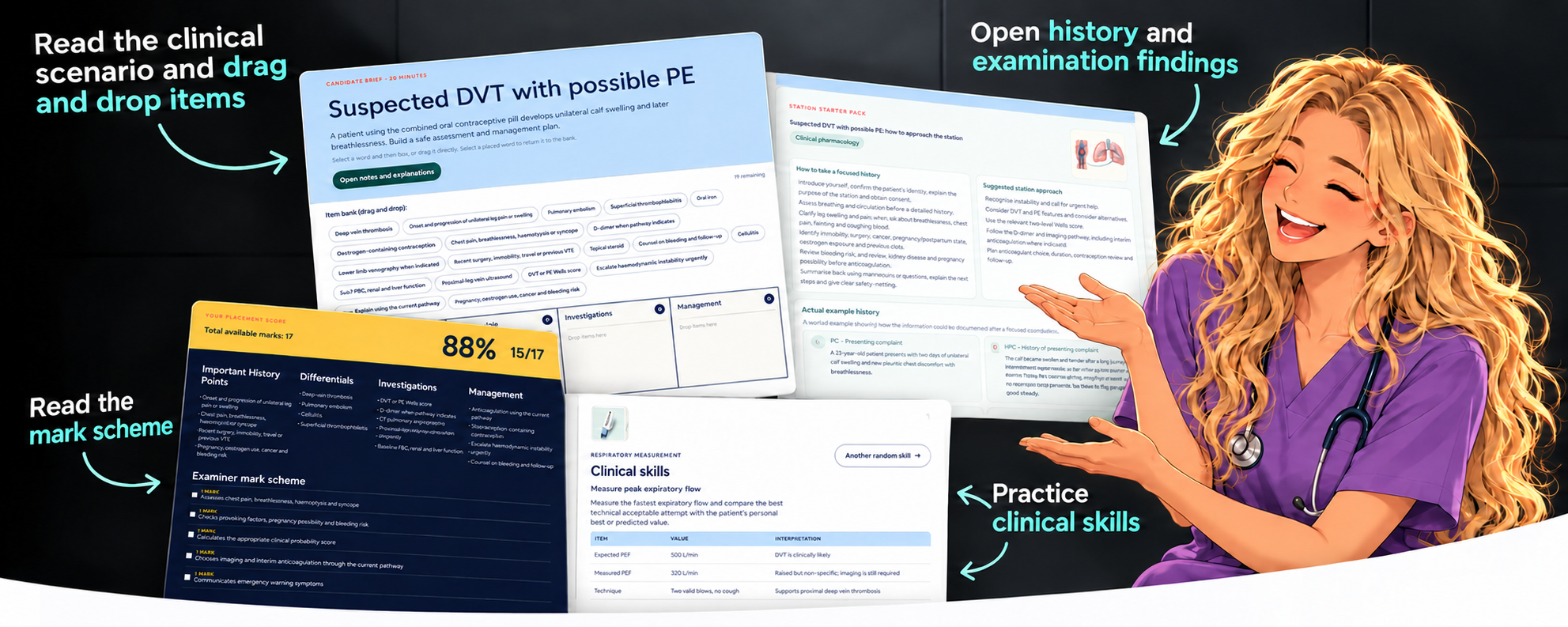
Clinical and Professional Skills Assessment (CPSA)
A practical clinical assessment, usually OSCE-based for medical students, testing communication, examination skills, clinical management, professionalism, and patient safety.
medical students must pass the MLA as part of their degree. International medical graduates taking the PLAB route sit assessments that comply with MLA requirements.
2. UKMLA AKT exam format
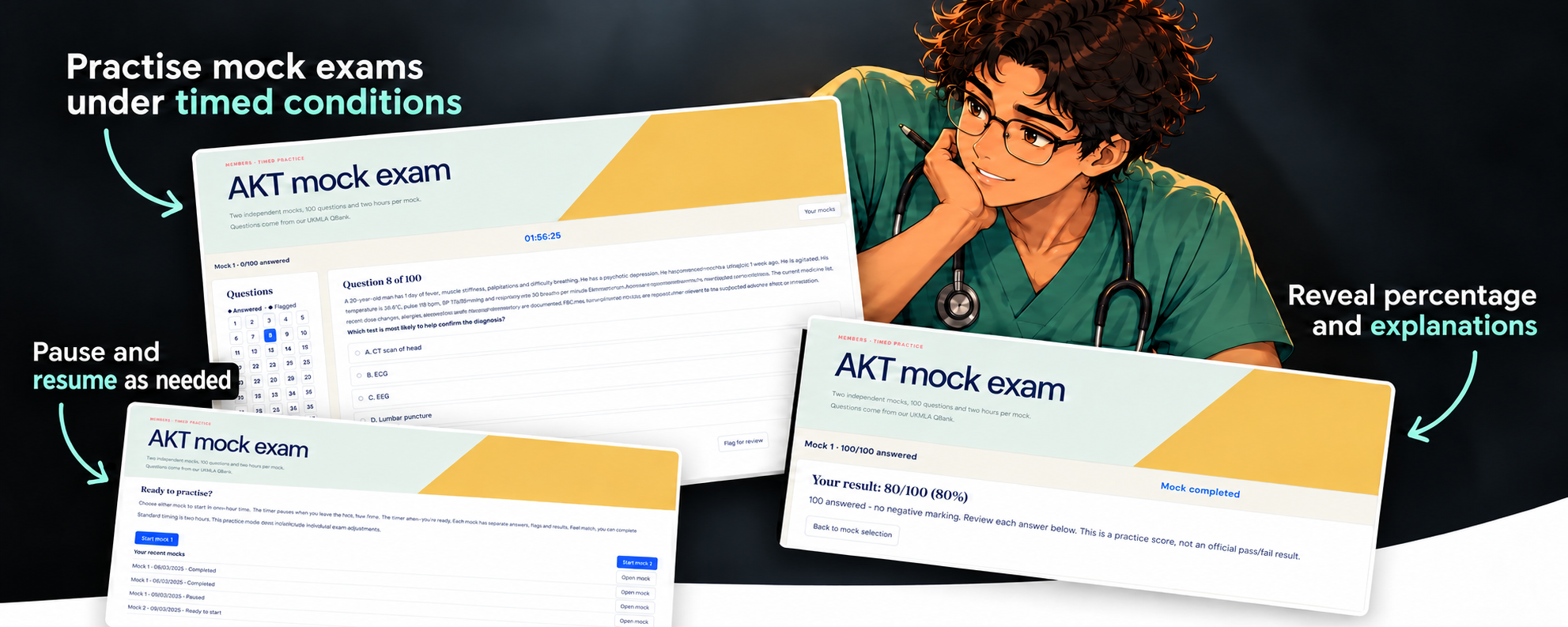
Understanding the AKT format helps you practise at the right pace and prepare for sustained concentration across both papers. Use the question totals and timings below to shape your timed practice, then check your own assessment arrangements before the exam. When reviewing a mock, consider how you used your time as well as which questions you answered correctly.
| Feature | Standard arrangement |
|---|---|
| Question type | Five-option Single Best Answer |
| Negative marking | None |
| Timing | Sequential days |
These are the standard medical school AKT arrangements, confirmed by the Medical Schools Council. Individual adjustments may apply. Check your medical school’s instructions for your own timings and arrangements.
The AKT is a pass/fail assessment. There is no universal fixed percentage that guarantees a pass; standard setting determines the passing standard for each assessment.
3. What does the UKMLA test?
The GMC’s MLA Content Map defines the clinical knowledge, capabilities, conditions and presentations that can be assessed; the current version applies to assessments from September 2026 onwards. Use it to organise revision around patient presentations and the decisions they involve. For each topic, practise recognising the diagnosis, choosing investigations, interpreting findings and deciding on appropriate management.
The exam covers a broad range of areas, including general medicine, surgery, paediatrics, obstetrics and gynaecology, psychiatry, emergency medicine, primary care, prescribing principles, ethics, safeguarding, and public health.
A particularly useful way to organise revision is around the following question types:
| Question type | What you must decide |
|---|---|
| Diagnosis | What is the most likely condition? |
| Investigation | What is the most appropriate test? |
| Interpretation | What do the findings indicate? |
| Management | What is the best treatment or action? |
| Prioritisation | What must happen first? |
| Ethics | What is the most professional, lawful and patient-centred response? |
Knowing a diagnosis alone is often insufficient. You also need to understand what to do next, how urgent the situation is, and what is appropriate in a clinical setting.
4. The most important exam technique: READ
READ gives you a repeatable way to approach a Single Best Answer question: read the final line, extract the key clues, assess urgency and decide on your answer before comparing the options. Finish by verifying that your choice answers the precise question and fits the patient’s situation. Following the same sequence helps you turn a long clinical stem into a focused decision.
👀 Read the final line first
Identify exactly what the examiner is asking.
🔍 Extract the key clues
Identify relevant symptoms, observations, time course, risk factors and investigation findings.
⏱️ Assess clinical urgency
Decide whether the patient is stable, deteriorating or has a time-critical problem.
🤔 Decide before looking at options
Formulate your likely diagnosis or best next action, then compare it with the available choices.
✅ Verify the best answer
Check that it answers the precise question, suits the clinical setting and is the safest appropriate option.
Why read the last line first?
A clinical scenario may contain a large amount of information, but the final line tells you what kind of reasoning is required.
- Most likely diagnosis: identify the condition.
- Most appropriate initial investigation: choose the first useful test.
- Most accurate diagnostic investigation: choose the most reliable test for confirming the condition.
- Most appropriate immediate management: prioritise stabilisation or urgent action.
- Most appropriate long-term management: focus on ongoing treatment, prevention, or monitoring.
The same patient scenario can generate different correct answers depending on what the question asks.
“Read the question’s final line, then let the clinical clues guide your answer.”
5. First, next, best and definitive
Words such as initial, immediate, next and definitive describe different stages of clinical care. Before choosing an option, identify which stage the question asks about and what has already been done. An investigation or treatment may be appropriate eventually but still be the wrong answer now, so match your decision to the patient’s current needs.
| Wording | Your approach |
|---|---|
| Initial | What should be done first in this situation? |
| Immediate | What needs urgent attention to prevent harm? |
| Next best step | Given what has already happened, what should happen now? |
| Most appropriate | Which option best balances benefit, risk and clinical context? |
| Definitive | What establishes the diagnosis or provides definitive treatment? |
A common mistake is choosing an option that would eventually be appropriate but is not appropriate at this stage.
For example, a patient with severe breathlessness and dangerously abnormal observations may need urgent assessment and stabilisation before a definitive investigation. For a stable patient, a diagnostic investigation might be the correct next step.
The correct option is the one that best matches the patient’s current needs. It is not necessarily the most advanced investigation or most aggressive treatment.
6. How to eliminate wrong answers
When the answer is not immediately clear, compare every option with the question’s wording, the key clinical clues, the urgency and the setting. Remove choices that fail one of these checks, then use the most discriminating detail to separate the remaining options. This makes elimination a reasoned process rather than a search for the most familiar answer.
- Wrong timing: appropriate later, but not now.
- Wrong diagnosis: does not explain the key clinical findings.
- Wrong priority: overlooks an immediate clinical risk.
- Wrong setting: inappropriate for the level of care available.
- Wrong question: medically true, but does not answer the final line.
If two options remain, compare them against the most discriminating detail in the scenario rather than asking which answer sounds more familiar.
“A familiar answer is only useful if it fits the timing, priority and question.”
7. Worked clinical question
A worked question shows how to turn the details in a clinical stem into a justified answer. Try the example below before revealing the reasoning: identify what is being asked, pick out the strongest clues and explain why the alternatives fit less well. This is an original educational example designed to practise UKMLA-style reasoning, not an actual examination question.
Recognising the diagnosis
A 68-year-old patient presents with sudden onset left-sided weakness and difficulty speaking, beginning 45 minutes ago. They are awake, have a blood glucose of 5.8 mmol/L and have no history of recent trauma.
What is the most likely diagnosis?
- Migraine with aura
- Acute stroke
- Bell’s palsy
- Peripheral neuropathy
- Menière’s disease
Reveal the answer and reasoning
B. Acute stroke. Sudden focal weakness with speech difficulty in an older patient makes acute stroke the best answer among these options. The normal glucose makes hypoglycaemia less likely as a mimic.
Bell’s palsy does not explain limb weakness, peripheral neuropathy does not explain this sudden pattern with speech difficulty, and Menière’s disease typically presents with vestibular and hearing symptoms. Migraine can mimic stroke, but this presentation requires urgent stroke assessment.
READ check: the question asks for the diagnosis. If it asked for immediate management or investigation, you would need to choose the appropriate urgent action instead. The scenario alone cannot distinguish ischaemic from haemorrhagic stroke.
8. Reason beyond the diagnosis
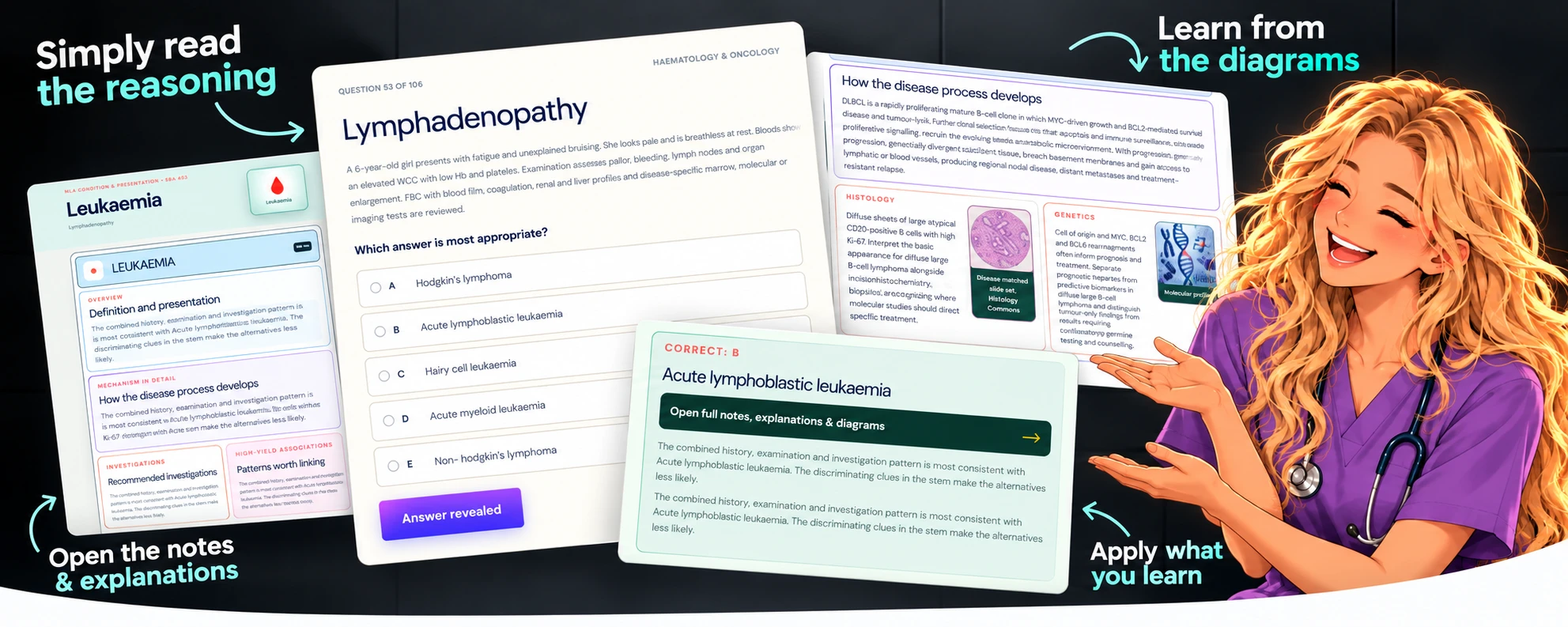
Many UKMLA questions require two or three reasoning steps: recognise the condition, identify the relevant clinical context, then decide what happens next. When revising, connect the diagnosis to the investigation or treatment decision and consider how patient factors could change it. These are steps in clinical reasoning; the MLA itself has two assessment components.
When learning a condition, go beyond a list of investigations and treatments. Ask:
- Which investigation is first-line, and which is the reference standard?
- What should happen next after the results already given?
- How does pregnancy change the investigation or management?
- What changes if the patient has an allergy or renal impairment?
- Could another medicine interact with the proposed treatment?
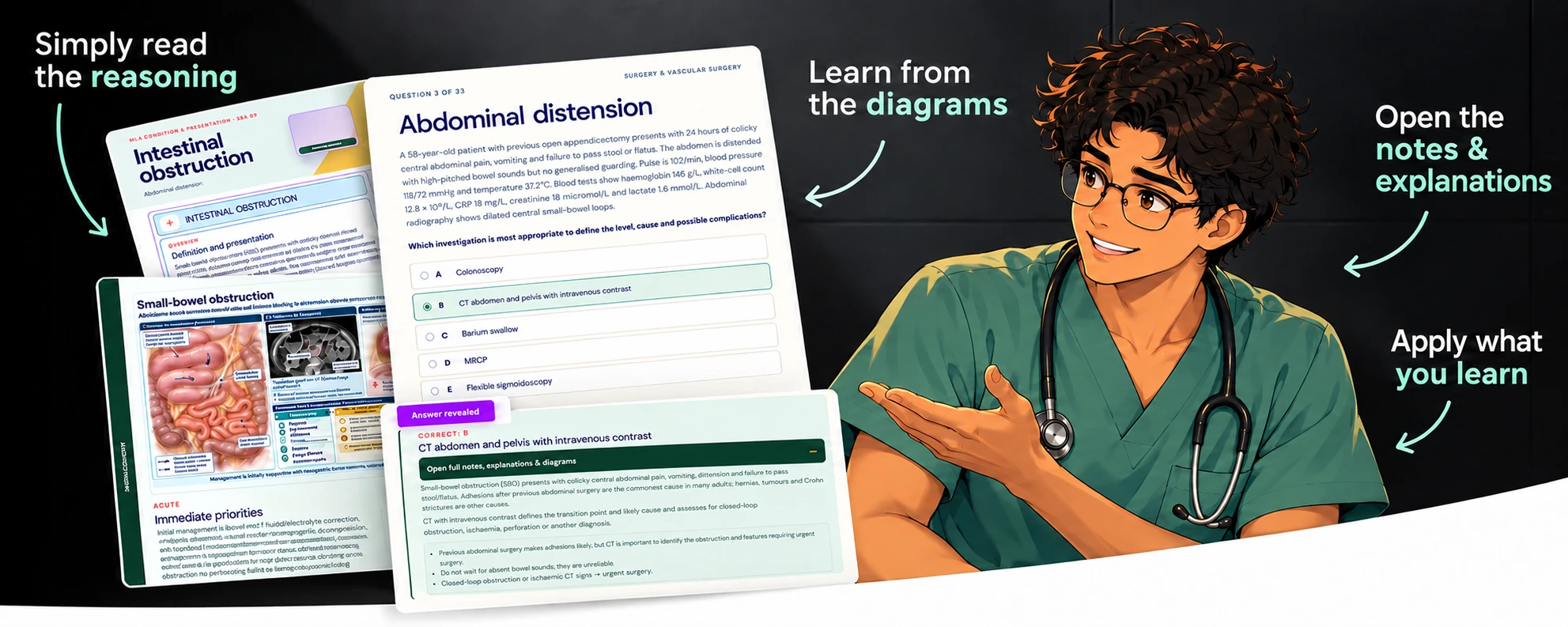
Start practice questions early to identify these gaps. Use published practice papers and legitimate question banks, then review why each answer is appropriate in that particular scenario.
Practise clinical reasoning in our Progress Test & UKMLA SBA bank.
“Recognising the condition is the start. The next step depends on the patient in front of you.”
9. A–E and immediate priorities
For an acutely unwell or deteriorating patient, use Airway, Breathing, Circulation, Disability and Exposure (ABCDE) to identify immediate threats and organise your next actions. Treat life-threatening problems as you assess, call for help early and reassess. In an SBA, apply this framework to the observations and actions already described, so you choose the priority that is still outstanding.
An obvious diagnosis does not remove the need to identify immediate threats. Ask yourself: what would I actually do next, given the observations and what has already been done?
Do not attribute reduced consciousness to alcohol alone. Assess A–E and check blood glucose to exclude hypoglycaemia, while considering other causes such as trauma. A glucose check must not delay treating an airway or breathing problem.
A–E is a framework for acute assessment, not an automatic answer to every SBA. Always answer the precise question and account for actions already completed.
“Think like a doctor: identify the immediate threat, act, and reassess.”
10. Check the clinical setting
The same diagnosis can require a different next step in a GP surgery, emergency department, ward or specialist clinic. The resources available, the clinician’s role and the urgency all affect what is appropriate. Read the setting as carefully as the symptoms, and decide whether the next action is assessment, treatment, escalation or specialist referral.
For example, suspected Parkinson’s disease in primary care calls for prompt specialist referral before treatment is started. Recognising a dermatological condition also does not automatically justify starting a treatment that requires specialist initiation or monitoring.
Do not ignore the setting because you have spotted a familiar buzzword. Read the whole stem and choose an action that is appropriate for that patient in that service.
“The same diagnosis does not always mean the same next step.”
11. Understanding beats memorising
Understanding a topic means being able to explain why a diagnosis fits and why a close alternative fits less well. Memorised facts can help you recognise a pattern, but comparing the supporting and conflicting findings makes your reasoning more useful in unfamiliar questions. Build revision notes around these comparisons, then practise explaining each answer in your own words.
Write the common differentials beside each condition in your notes. Record the findings that support your diagnosis and the findings that would favour the alternative.
“This is X because of A, B and C; whereas Y would be more likely if D and E were present.”
After each question, explain the answer in your own words. If you cannot explain why the nearest alternative is wrong, revisit that comparison.
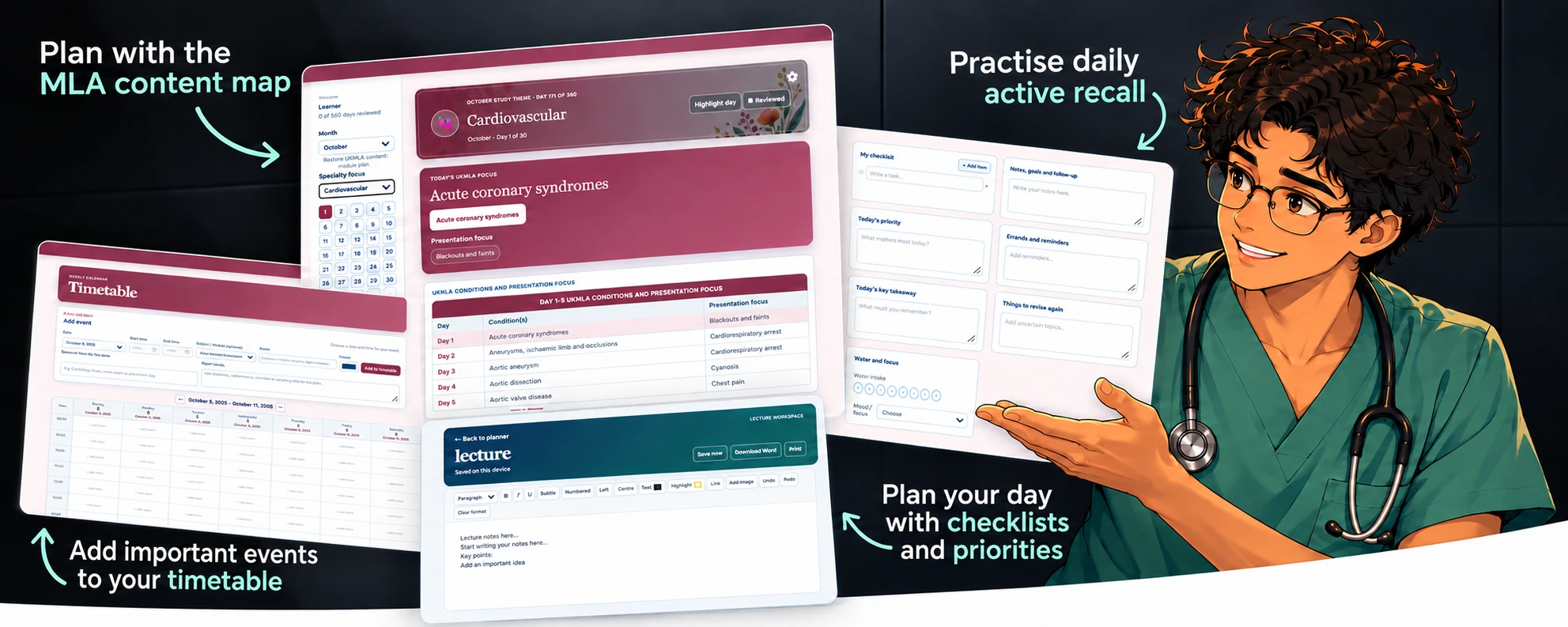
Use our UKMLA topic notes to revisit the clinical concepts behind your answers.
12. Know your medicines properly
Knowing a medicine properly means connecting how it works with when it is used and how it can cause harm. Learn its mechanism, indications, important side effects, contraindications and interactions together, rather than remembering only a drug–condition pairing. This helps you distinguish similar answer options and recognise when patient factors change the safest choice.
For each important medicine or drug class, understand:
- Mechanism of action: how it produces its effect.
- Indications: when and why it is used.
- Important side effects: what to recognise and monitor.
- Contraindications: when it may be unsuitable.
- Interactions: which other medicines change its safety or effect.
Also consider pregnancy, renal function, allergies and monitoring requirements. Similar answer options may differ on one of these details; knowing the mechanism and safety profile can help you distinguish them.
Use current prescribing references and local guidance when checking drug-specific details.
Worked example: salbutamol
A patient’s wheeze improves after inhaled salbutamol. Soon afterwards, they notice mild hand tremor and a faster heartbeat.
Which mechanism best explains the medicine’s intended effect?
- Blocking beta-2 receptors
- Stimulating beta-2 receptors in airway smooth muscle
- Blocking muscarinic receptors
- Suppressing airway inflammation through glucocorticoid receptors
- Blocking histamine H1 receptors
Reveal the answer and reasoning
B. Stimulating beta-2 receptors in airway smooth muscle. Salbutamol is a short-acting beta-2 agonist. It relaxes airway smooth muscle to produce rapid bronchodilation.
Connect the mechanism to safety: tremor and a transient faster heartbeat are recognised side effects. Low potassium can occur, particularly with intensive treatment, so the clinical context and monitoring matter.
Compare the alternatives: muscarinic blockade describes medicines such as ipratropium; glucocorticoid receptor activity describes corticosteroids. Neither is salbutamol’s mechanism. Beta blockers can interfere with its effect and require careful clinical assessment.
Go beyond the mechanism: salbutamol provides symptom relief; it does not replace anti-inflammatory asthma treatment. Increased reliever use or worsening symptoms should prompt review of asthma control and the treatment plan.
READ check: this question asks how the medicine works. If it asked for management of a deteriorating patient, you would need to assess urgency and choose the appropriate next action.
“Understand how a medicine works, when it helps, and when it could cause harm.”
13. Put it into practice
Build a revision cycle you can repeat: attempt questions, review the reasoning, record the gap, and revisit it. Include timed practice so you become comfortable with the pace of the exam.
Two hours for 100 questions gives an average of 72 seconds per question under standard timings. Use your own allocated time if you have adjustments. Avoid spending too long on one difficult question, and answer every question because there is no negative marking.
Practise SBAs
Apply READ to clinical scenarios and identify the topic areas you need to revisit.
Review the concepts
Compare diagnoses, clarify investigations and connect treatment choices to the clinical setting.
Prepare for the CPSA
Build your communication, examination and clinical assessment skills alongside written revision.
Plan your revision
Make space for question practice, topic review and returning to difficult areas.
“Every reviewed mistake can become a clearer decision next time.”