
UKFPO · Foundation Programme guide
Foundation Programme Guidance
There is no universally perfect Foundation School. The useful question is simpler: which option gives you the best combination of support, location, rotations and opportunities for the next two years?
First, forget some of the old advice. The standard Foundation Programme no longer uses your Educational Performance Measure or Situational Judgement Test score to create an allocation rank.
The system has changed
Since 2024, the Preference Informed Allocation process—usually shortened to PIA—has used a computer-generated rank for standard Foundation Programme allocation. It is not a ranking of your exam results, medical school or academic performance.
The same rank follows you through each stage: Foundation School, group and then programme. That makes the order of your preferences genuinely important, so rank the places you truly want rather than trying to guess what feels “safe”.
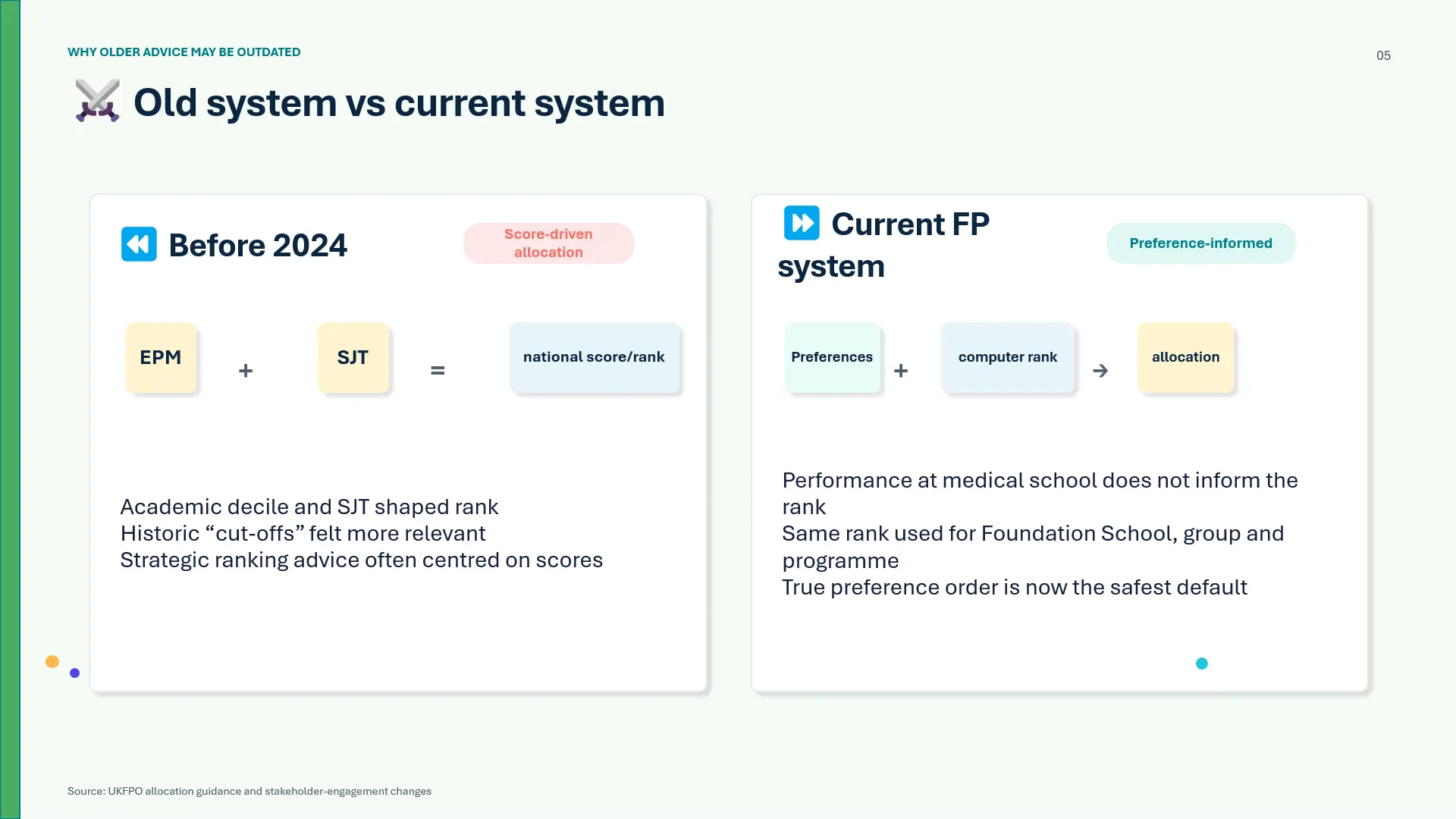
Under the former system used before 2024, each applicant received a national Foundation Programme score. This combined the Educational Performance Measure (EPM), which reflected academic performance at medical school, with the Situational Judgement Test (SJT), a separate national assessment of professional judgement.
Applicants still ranked the Foundation Schools and programmes they preferred, but allocation was processed in order of the combined FP score. When a school or programme was oversubscribed, applicants with a higher score had priority for the available places they had ranked. Preparation therefore focused both on building the strongest possible FP score and arranging preferences carefully.
Under the current PIA system, EPM and SJT scores are not used for standard Foundation Programme allocation. After preferencing closes, Oriel assigns every eligible applicant a computer-generated rank that is not based on their medical school or academic performance. The same rank is used for Foundation School, group and programme matching, rather than issuing a new rank at each stage.
Allocation takes place in two passes. During the first pass, Oriel works through applicants in computer-generated rank order and tries to allocate each person to their first-choice Foundation School. If that choice is already full, the applicant remains unplaced for the moment. During the second pass, Oriel works through the remaining applicants again and allocates each person to their highest-ranked preference that still has a vacancy.
In practical terms, the old system rewarded a stronger combined FP score, whereas the current system separates allocation from medical school performance. You cannot improve or predict the generated rank, but you can control the order of your preferences. Put them in your genuine order of choice: ranking a competitive option first does not make your lower choices disappear if that first option is already full when the algorithm reaches you.
Competitive school or closer to home?
This is where many applicants get stuck. A school may sound exciting on paper, but your day-to-day experience will also be shaped by travel, housing costs, the people around you and the rotations you actually receive.
A more competitive Foundation School is not automatically a better personal choice. Competition figures mainly show how many people ranked an area highly in a particular year; they do not measure the quality of every programme within it, guarantee a preferred hospital or tell you whether the location will suit your circumstances.
Start by separating your non-negotiables from your preferences. A non-negotiable might be staying within reach of a support network, keeping housing affordable or avoiding a commute that would be difficult without a car. A preference might be a particular city, specialty or teaching opportunity. This makes it easier to compare two schools without letting reputation outweigh the factors that will affect you every week.
Support and familiarity. Being near family, friends or an established community can make busy rotations easier to manage. If you are moving, think about how quickly you could build a new support network and whether you would feel comfortable living in the area for two years.
Cost and commuting. Compare rent with the full cost of getting to work, including fuel, parking or public transport. A cheaper home can become less practical if an early start, late finish or distant hospital creates a long and unreliable commute.
Rotations and learning. Look beyond one favourite specialty. Consider the whole programme, the mix of hospital and community placements, supervision, teaching and whether the rotations give you a balanced foundation for your next career decision.
Lifestyle and sustainability. Ask what ordinary weeks would feel like, not just what the region offers on a free weekend. Housing, travel, access to the things you value and enough time outside work can all affect whether a programme feels sustainable.
Prestige is one line on a list. Support, commute and quality of life turn up for every shift.
Before finalising your order, test each option against an ordinary working week. Check likely housing areas, the journey to the furthest hospital in the school or group, and how you would manage early, late or weekend travel. Then review the programmes you would be most and least happy to receive. If the less attractive realistic outcome still works for you, the school may deserve a higher place on your list.
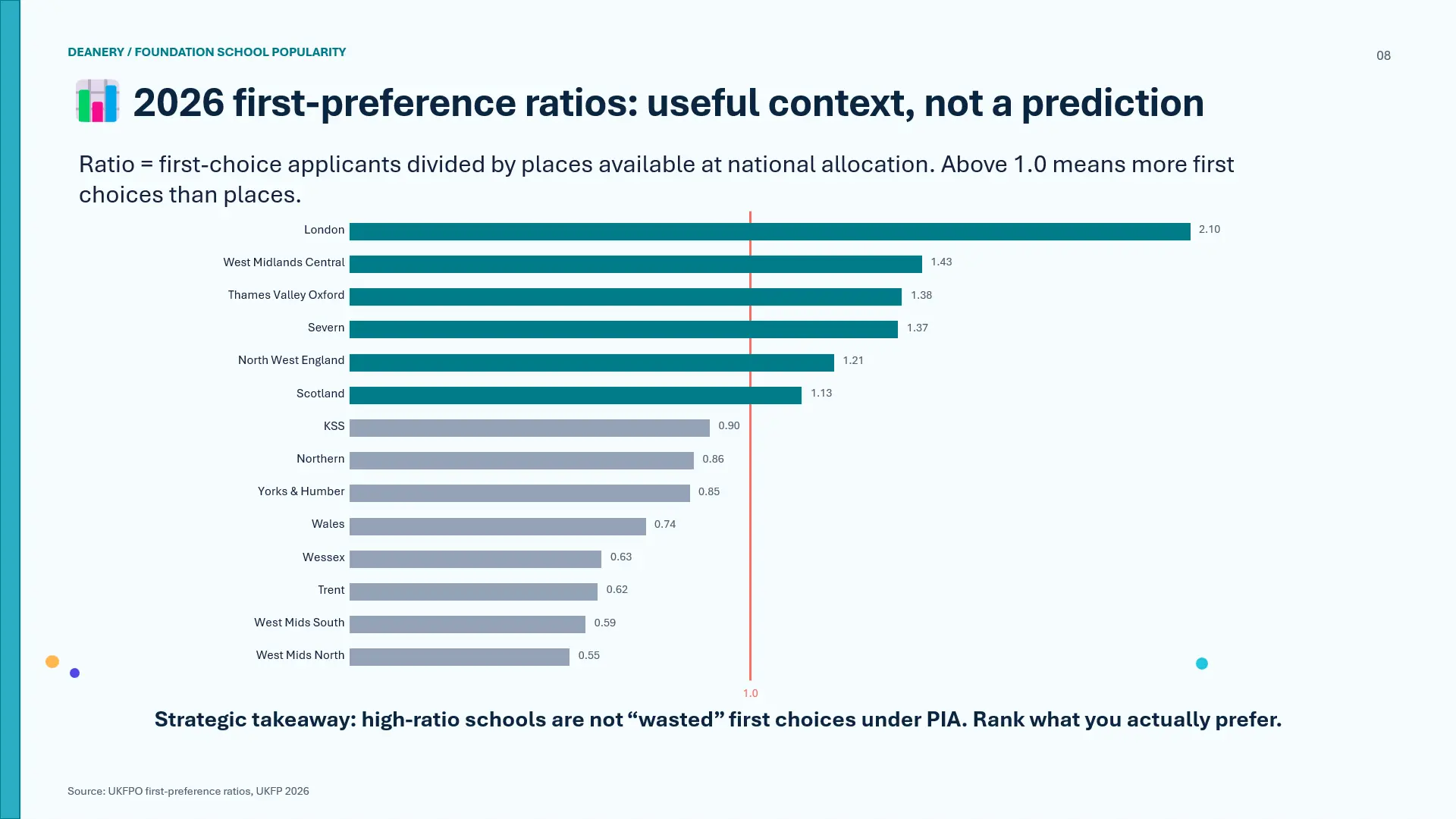
Competition ratios are useful context, not a prediction. For 2026, London received 2.10 first preferences for every place, while Wessex received 0.63. Those figures describe one application cycle; they do not tell you where your computer-generated rank will fall or what other applicants will choose next time.
A first-preference ratio compares the number of available programmes with the number of applicants who ranked that Foundation School first. A ratio of 2.10 is roughly equivalent to 210 first preferences for every 100 places, while 0.63 is about 63 first preferences for every 100 places. A figure above 1.00 therefore shows that first-choice demand exceeded the number of places; a figure below 1.00 shows fewer first choices than places at that point in the process.
This does not translate into an individual percentage chance of being allocated there. Under Preference Informed Allocation, the outcome depends on the computer-generated order, the preferences submitted by that year’s applicants and the two-pass matching process. The published tables can also show different versions of the ratio, including all applicants, primary-allocation applicants and figures after pre-allocation or manual matching, so check which column you are comparing.
Ratios also describe demand for the Foundation School as a whole, not for an individual group, hospital or rotation. A school with a lower ratio may still contain programmes that many applicants rank highly, while a school with a higher ratio may include a wide range of locations and programme combinations. Use several years of data to understand broad patterns, then base your order on where you would genuinely prefer to train rather than attempting to predict or outsmart the allocation.
The official UKFPO tables explain the calculation and distinguish the available ratio measures. Review the current figures on the UKFPO first-preference ratios page, as programme numbers and applicant behaviour can change each year.
Build your real preference list
Start with the life you want to have during Foundation training, then work outwards. A quick first draft can be built around five questions:
- Support network: who will be nearby after a difficult week?
- Geography and commute: how far could you realistically travel for an early start?
- Cost and lifestyle: what will rent, transport and your preferred way of living look like?
- Rotations: which specialties would you value, and which combinations would you rather avoid?
- Opportunities: are you looking for teaching, research, leadership or quality-improvement experience?
Which Foundation Programme route fits your goals?
The routes share a common focus on safe clinical practice and professional development, but the structure and added opportunities can be quite different. Look beyond the name and compare what you would actually do during each placement.
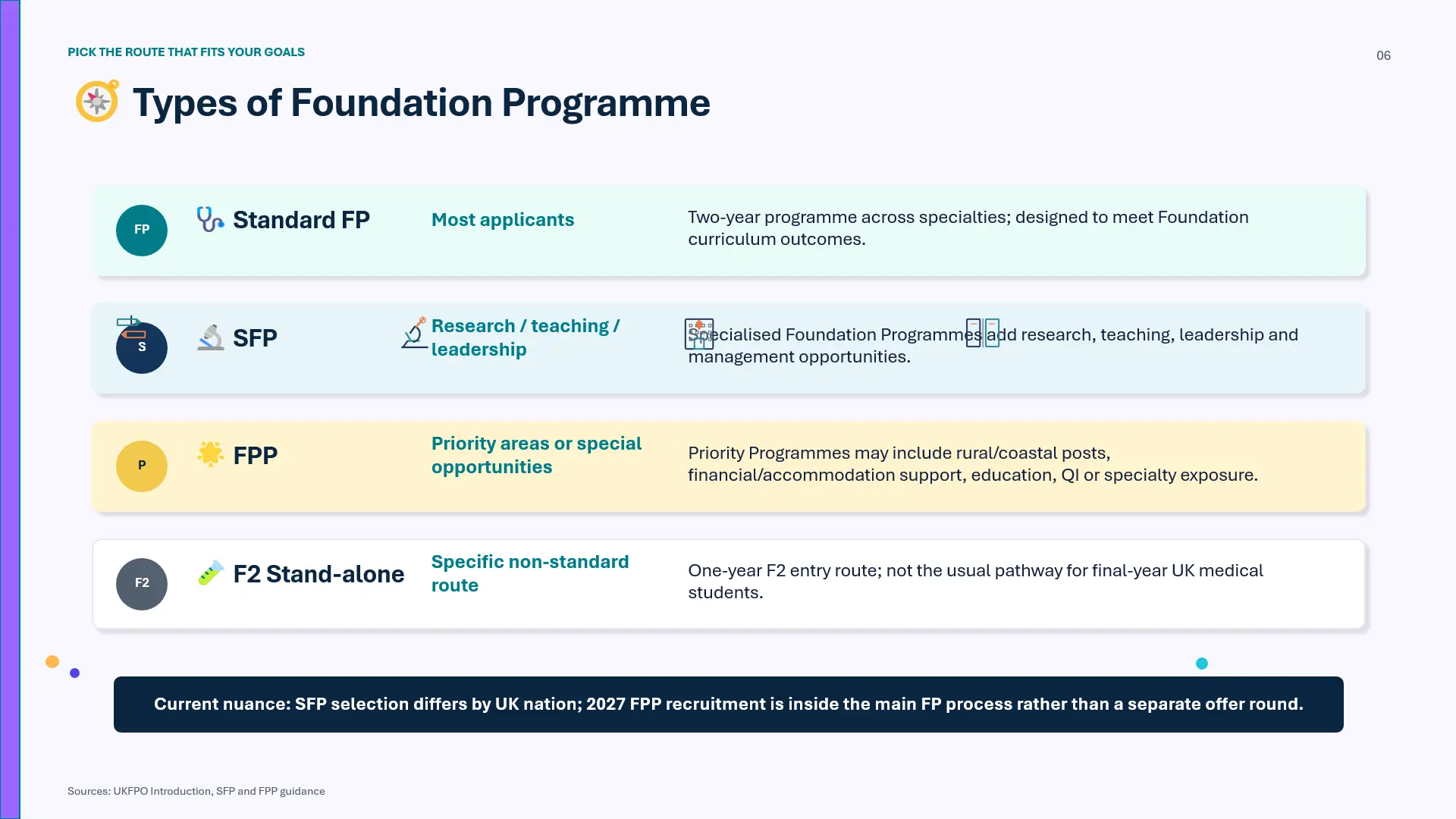
Standard Foundation Programme (FP)
The main route for most applicants
A two-year programme covering a range of specialties and clinical settings. You complete supervised placements while working towards the Foundation Programme Curriculum outcomes needed for progression into further training or other career routes.
Specialised Foundation Programme (SFP)
Research, teaching, leadership or management interests
SFPs combine ordinary Foundation training with protected or structured time for an area of special interest. Opportunities differ between regions, so compare the actual project, supervision, timetable and selection process rather than relying on the SFP label alone.
Foundation Priority Programme (FPP)
Priority locations and programmes with added opportunities
FPPs are designed to attract applicants to particular areas or specialties. Depending on the programme, they may include financial or accommodation support, education, quality improvement, rural or coastal experience, or focused specialty exposure.
F2 stand-alone route
Doctors seeking a specific one-year F2 entry route
This is a one-year route into Foundation Year 2 rather than the usual pathway for final-year UK medical students. National UKFPO recruitment is ending from 2027, although individual employers may still advertise suitable local vacancies.
Check the balance between service commitments and the advertised opportunity, who provides supervision, whether protected time is guaranteed, and how the programme fits your preferred location and longer-term goals.
Do not stop at the Foundation School name
Your final job is usually decided in three layers: Foundation School → Group → Programme. A broad regional choice can contain very different hospitals, travel times and rotation combinations.
For 2025, Foundation Schools in England, Scotland and Wales used groups, while Northern Ireland did not. Check the current cycle’s programme information before assuming the same structure applies everywhere.
1. Foundation School. This is the broad geographical or administrative area you rank first. A single school may cover several trusts, towns and hospital sites, so choosing the region does not guarantee that you will be based in one particular city or hospital.
2. Group. Where groups are used, they divide a Foundation School into smaller geographical or organisational collections of programmes. Group boundaries can make a major difference to commuting, moving house and which hospitals are available to you.
3. Programme. This is the specific sequence of placements you could receive across F1 and F2. Compare the specialties, hospital and community sites, the order of rotations and whether the programme involves changing location during the two years.
Treat each layer as a separate decision. First ask whether the Foundation School works for your wider location and support needs. Then check whether you would genuinely be happy with every group you rank, including its furthest hospital sites and realistic travel times. Finally, compare the individual programmes by their full rotation combinations rather than focusing on one attractive specialty.
Programme names and codes can look similar, so use the current cycle’s official programme information alongside Oriel. Check which trust employs the post, where each placement is based, whether the site changes between F1 and F2, and whether any rotations are in community or more distant locations. Details can change between application cycles, even within the same Foundation School.
Open the current programme list and map the journey to every site in the groups and programmes you are considering. Preferences do not autosave in Oriel, so use a desktop or laptop browser, save after every change and take a final screenshot or export for your own records.
Recent recruitment changes to check
Specialised Foundation Programmes
SFP opportunities are broader than academic research alone and may include leadership, teaching and quality improvement. Recruitment arrangements can vary by region.
Foundation Priority Programmes
FPPs sit within the main Foundation Programme application process, so check each programme’s additional opportunities before you rank it.
Prioritisation
From August 2026, allocation prioritisation changes affect who receives offers first. Read the current UKFPO eligibility and prioritisation guidance carefully.
F2 stand-alone posts
National UKFPO recruitment to F2 stand-alone posts is ending from 2027, although individual employers may still advertise local vacancies.
Important dates to take note of
UKFP 2027 application window
- Applications opened
- 23 September 2026
- Applications close
- 7 October 2026 at 12:00 BST
- Review preferences
- Before 10 February 2027
The short version
Rank in your genuine order of preference. Look beyond the regional name. Compare the actual programmes, and give practical factors the same attention as career opportunities. Your best list is the one that reflects what matters to you—not what sounds impressive to somebody else.
This article summarises the uploaded UKFPO Foundation Programme Guide. Dates, programme structures and recruitment rules can change; always confirm the current cycle on the official UK Foundation Programme website.